Opinions
We are Cannibals?: Stories, Narratives, Sites.
We are cannibals , we eat people!
We eat thee, we eat people
We eat the brains of a dog
And that of a little child
We eat the fingers of people
We eat the fat of mankind
Thou toy of the man eaters
Thou delicious morsel
Strike, strike him down, my comrades
This is a stanza from a song collected by Thomas Abbousett in 1836 and often quoted, that the cannibals used to sing while dancing round a victim. It talks to the unique link that narratives of cannibalism are related to by Basotho.
I recently presented a paper at a Eugene Casalis Symposium in Morija Lesotho. Eugene Caslais was one of the first French missionaries to arrive in Lesotho in 1833 and would become a confidante, interpreter, friend and chronicler of Mosheshoe1. Reading Mbongiseni Buthelezi’s article Cannibals, Ancestors and the Future, Musa Hlatshwayo’s “Nomadic Cannibals” Ilanga Newspaper’s Historical take on Amabhele and Jo-Anne Duggan’s “Cannibals as ancestral graves: Moshoeshoe’s devoured grandfather” in the December issue prompted me to share my encounter with stories of cannibalism in Lesotho. My interest in Cannibalism in Lesotho was inspired by a curiosity sparked by the way in which Basotho relate to stories of cannibalism, in their conversations and also in official literature and historical accounts. Being an expatriate in Lesotho, reading about Cannibalism in the historical texts and listening to casual conversations on cannibalism, sharing the same corridor space with colleagues who claim direct descendants of cannibals that Moshoeshoe 1’s grandfather in 1824, made me develop a curious if somewhat skeptical attitudes to oral and written narratives of human eating activities in the 1820s and 30s in Moshoeshoe’s young nation.
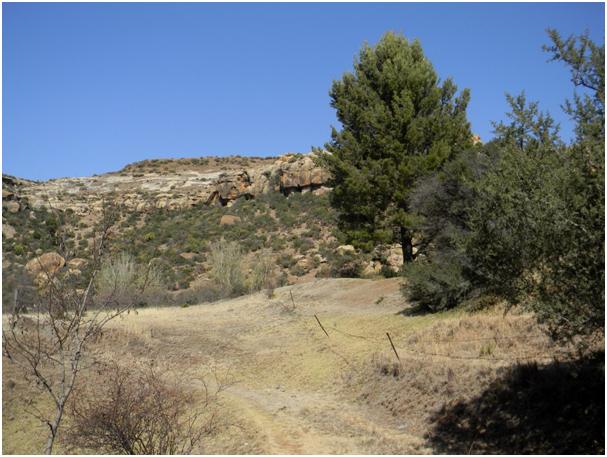
I read the missionary accounts of cannibalism and here fact mixes with fantasy, myth, fetishisation and gross exaggerations. Then I talked to a few descendants. There are family known to be descendants who have a rather casual and unconcerned attitude to their cannibal ancestry. I visited a series of cannibal sites dotted all over Lesotho and at these I could only wallow in wild imaginations of the horror acts that would have transpired in the quiet and serene caves.
A cannibal cave site in Mafeteng, Lesotho
In Lesotho, reports of cannibalism are associated with the lifaquane. These stories and stil exist in oral narratives, and widely documented in missionary documents are ‘evidenced’ in the physical manifestation of numerous ‘cannibal’ sites in the landscape. Accounts of cannibalism associated with the effects of the Mfecane/Lifaquane in pre-colonial Lesotho have constituted a part of the narrative of the history of the making of Lesotho. These were picked up by and recorded by early missionaries. The stories of cannibalism in still exist in literary works, oral stories, history texts and casual conversations. The stories are complemented by the existence of a series of caves and other sites associated with cannibalism in the landscape. My paper looked at how the practice of cannibalism, represented in oral narratives, missionary accounts and cannibal sites. The paper attempted to show how the narratives have always been ‘a usable past’ employed to construct images of the making of Lesotho as a nation and also made a case for a relook the missionary accounts.
The source of our information for my paper were three missionary accounts published between 1840 and 1870. The first book was “Missionary Excursion” by Thomas Abbousett, based on his excursion with Moshoeshe 1 during which they spend two days among the descendants of cannibalism (albeit rehabilitated ones) at Penane (Malimong). The second was by Eugene Casalis, also a member of the first group of missionaries titled “The Basutos”, first written 1856. The third one was published in 1861 by D.F. Ellenberger, another missionary who arrived in the 1860s in Lesotho. These texts have formed the basis from which the narratives on cannibalism sprung and most of the accounts on cannibalism replicated in many modern history books and oral recollections. They all gave vivid descriptions of cannibalism in Lesotho. For example in Ellenberger’s account he estimated that the cannibals of Lesotho numbered up to 4000. He also projected the affected numbers arguing that of the 4000 if one cannibals ate one person a month, 48000 would be eaten annually which means between 1822 and 1828, 288 000 people were eaten. Woow!!!!!
As of today one of the spaces where the motif of cannibalism is used is in many descriptions of the political and diplomatic wit of Moshoeshoe 1 and also in many writings describing Lesotho as an adventure destination for tourists. The idea of the cannibal and the practice of cannibalism in Lesotho still forms a greater part of the imaginary. The imaginary of Lesotho as a nation, of the historical processes of the making of the nation, even ethnic and group identity. In many accounts on Moshoeshoe 1 is presented as diplomat, the noble leader who not only accepts missionaries but forgives and rehabilitate cannibals. That Moshoeshoes’s power and influence grew as he offered a friendly hand to his defeated enemies, giving them land and assistance to cultivate crops. In a film ‘King Moshoeshoe’ devoted to the life of King Moshoeshoe 1, screened at the University of the Free State in October 2004 and on SABC2 television in November 2004, Moshoshoe 1’s diplomacy is said to have influenced modern South African leaders and the example, of Moshoeshoe 1’s action in making peace with the cannibals who had eaten his grandfather is compared to Nelson Mandela’s act of reconciliation in taking tea with Betsy Verwoerd.
The accounts have also inspired a genres of literary work and features prominently in recorded oral histories, folklore and legends in Lesotho. From Thomas Mofolo’s “Chaka” (1909) to Antjie krog’s “Begging to be Black” (1998) , scores of music and folklore, narratives of cannibalism are used to portray Moshoeshoe 1 as an astute, benevolent leader whose tact was way ahead of his time.
David Coplan’s book “The Time of Cannibals: The Word Music of South Africa’s Basotho Migrants” shows at how the image of the cannibal was largely employed in the musical traditions of Basotho Migrant workers in South African mines revealing the relationship between Basotho workers and the local and South African powers that be as the “cannibals” who lived off of their labor.
In Southern Africa the image of cannibal has survived for nearly two centuries and will probably continue to inspire more stories, invoke ire or in the case of Lesotho, used to construct a narrative of leniency, diplomacy and leadership of the founders of the nation!
Jesmael Mataga is a PhD fellow in the UCT Archive and Public Culture Forum